 English
 Spanish
 Portuguese
 French
 Italian
 Remote Mower
Maintaining grass and vegetation on steep slopes, uneven ground, and challenging outdoor sites requires more than ordinary mowing equipment. Traditional lawn mowers may struggle with traction, maneuverability, and cutting consistency when operating on rough terrain. For landscaping contractors, property managers, agricultural operators, and vegetation maintenance teams, selecting the right equipment is essential for improving productivity and maintaining safer working conditions.
A remote controlled lawn mower offers a practical solution for these demanding environments. By allowing operators to control mowing operations from a distance, this type of machine can help reduce direct exposure to hazardous terrain while delivering consistent vegetation management performance.
This professional case study explores how to evaluate a remote controlled lawn mower for difficult terrain, which technical features matter most, and how businesses can make an informed equipment investment. The scenario is illustrative rather than a report of a verified customer project. For more information about professional remote-controlled mowing equipment, visit JY Lawn Mower.

1. Understanding the Challenges of Difficult Terrain
Before selecting a remote controlled lawn mower, professionals must understand the specific conditions of the worksite. Terrain affects machine stability, traction, cutting performance, transportation requirements, and overall operating costs.
Steep Slopes and Embankments
Slopes are among the most demanding areas to maintain. A conventional mower may become difficult to control when operating across uneven inclines, particularly where the ground is loose, damp, or covered with thick vegetation.
A remote controlled lawn mower allows the operator to stand at a more suitable location while controlling the machine. However, remote operation alone does not guarantee safe slope performance. Buyers must confirm the manufacturer's rated working gradient, recommended operating direction, ground-condition limitations, and applicable safety procedures.
For embankments, drainage channels, roadside banks, and other sloped areas, a machine engineered specifically for incline mowing can offer important operational advantages.
Uneven Ground and Obstacles
Rocks, exposed roots, ruts, and irregular surfaces can interrupt cutting and increase mechanical stress. The best remote controlled lawn mower for these conditions should provide suitable ground clearance, durable construction, stable movement, and a cutting system designed for the vegetation and terrain involved.
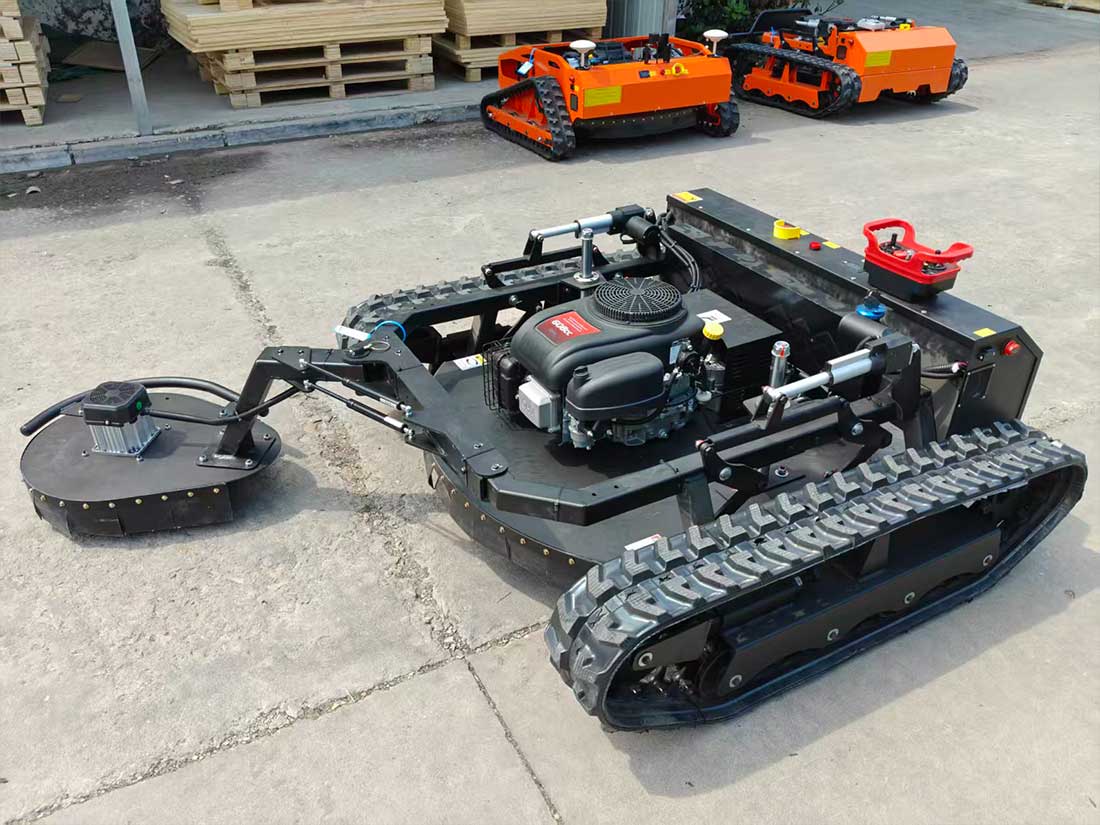
Tracked machines may provide useful traction on certain rough surfaces, although track design, soil conditions, machine weight, and turning technique all influence actual performance.
Dense Grass and Overgrown Vegetation
Thick grass, weeds, and light brush can place substantial demands on the cutting system. A machine with insufficient cutting power or an unsuitable deck may produce inconsistent results, slow down frequently, or require repeated passes.
Professionals should match the remote controlled lawn mower's engine or motor output, cutting width, blade configuration, and cutting-height adjustment to the vegetation they need to manage.
2. Case Study Scenario: Evaluating Equipment for a Challenging Site
Consider a landscaping contractor responsible for maintaining a property with three distinct areas: a steep grass embankment, a rough section containing shallow ruts and scattered obstacles, and a relatively level field with dense seasonal growth.
The contractor initially considers using conventional mowing equipment throughout the property. However, the steep section presents access and stability concerns, while the uneven ground makes consistent cutting difficult. The team therefore evaluates a remote controlled lawn mower designed for demanding outdoor maintenance.
Rather than choosing a machine based solely on its advertised power or maximum slope angle, the contractor establishes a structured evaluation process.
Step 1: Assess the Site
The first step is to document the working environment, including:
Slope gradients and the length of inclined sections.
Soil type, surface firmness, and drainage conditions.
Grass height, vegetation density, and expected seasonal growth.
Obstacles, narrow access points, and transportation routes.
Available operator positions and potential exclusion zones.
Daily mowing requirements and expected operating hours.
This assessment helps determine whether one remote controlled lawn mower can handle the entire property or whether different equipment or working methods are required for separate areas.

Step 2: Define the Required Performance
The contractor identifies the primary objectives: maintain vegetation consistently, reduce the need for operators to walk on hazardous slopes, manage dense growth efficiently, and minimize unnecessary downtime.
These objectives become the basis for comparing machines. A remote controlled lawn mower that performs well on level grass may not be appropriate for steep embankments or rough ground. Equipment suitability must be evaluated against the actual worksite rather than general product descriptions.
Step 3: Compare Suitable Machine Designs
The contractor reviews machines with different track systems, cutting decks, power outputs, and control features. The goal is to identify a remote controlled lawn mower that balances traction, stability, cutting performance, maintainability, and total ownership cost.
A controlled site trial, conducted within the manufacturer's operating limits, can help validate the selection before the equipment is deployed across the entire property.
3. Key Features to Look for in a Remote Controlled Lawn Mower
Selecting professional mowing equipment requires a technical assessment of several interconnected features.
Traction and Track Design
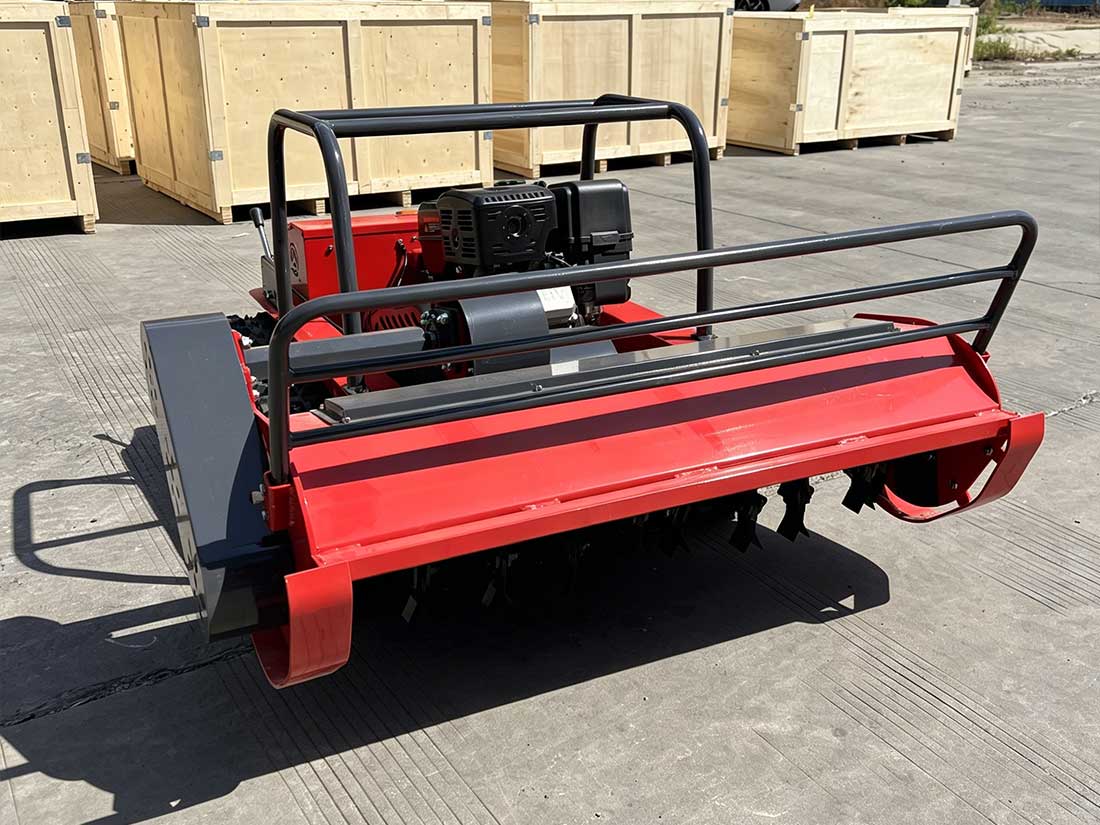
Traction is essential when working on inclines and irregular surfaces. A tracked remote controlled lawn mower can distribute its weight over a larger contact area than some wheeled designs, potentially improving grip and reducing localized ground pressure.
Nevertheless, performance varies with track width, tread pattern, machine weight, center of gravity, and soil conditions. Wet grass, loose soil, mud, and abrupt changes in slope can all affect stability.
Buyers should ask manufacturers for documented slope specifications and clarify whether those figures apply to straight-line travel, side-slope operation, or specific ground conditions.
Engine Power and Cutting Capacity
Power requirements depend on the vegetation, terrain, cutting width, and operating speed. Dense grass and heavy weeds generally demand more cutting capacity than regularly maintained lawns.
A suitable remote controlled lawn mower should provide enough power to maintain effective cutting under the intended workload. A wider cutting deck may improve productivity in open areas, but it is not automatically the best option for narrow access routes or obstacle-filled sites.
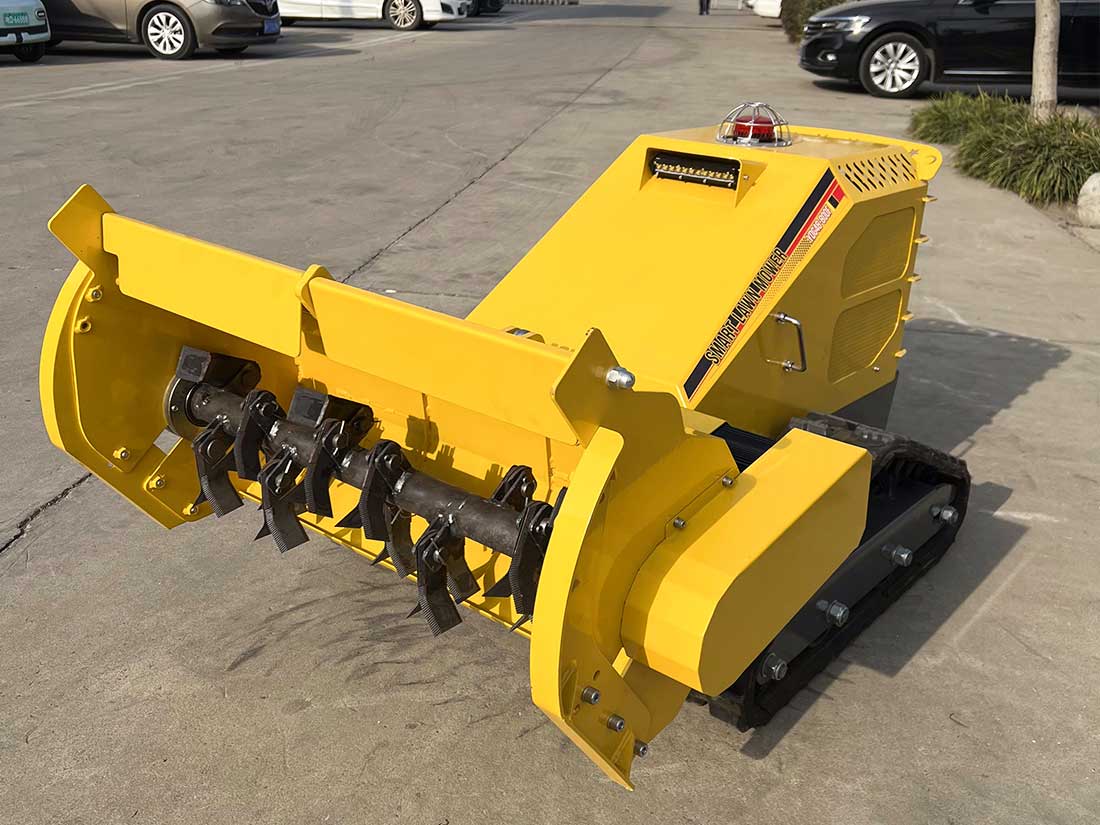
Professionals should also examine the cutting system. Rotary decks may suit many routine grass-cutting tasks, while flail-style systems can be appropriate for certain tougher vegetation, depending on the machine's design and approved application.
The final choice should reflect the site's vegetation rather than relying on cutting width or power figures alone.
Remote Control Range and Responsiveness
A dependable control system is fundamental to remote-controlled operation. Operators should evaluate control responsiveness, signal reliability, visibility of the machine, emergency-stop functions, and the manufacturer's guidance for maintaining a safe operating distance.
The stated control range should not be treated as a guarantee of safe operation under every condition. Buildings, vegetation, terrain, interference, and line-of-sight limitations may affect communication.
For professional use, a remote controlled lawn mower should have clearly documented control procedures and appropriate safety features. Operators must remain attentive, maintain the required visual awareness, and follow site-specific risk assessments.
Stability and Machine Construction
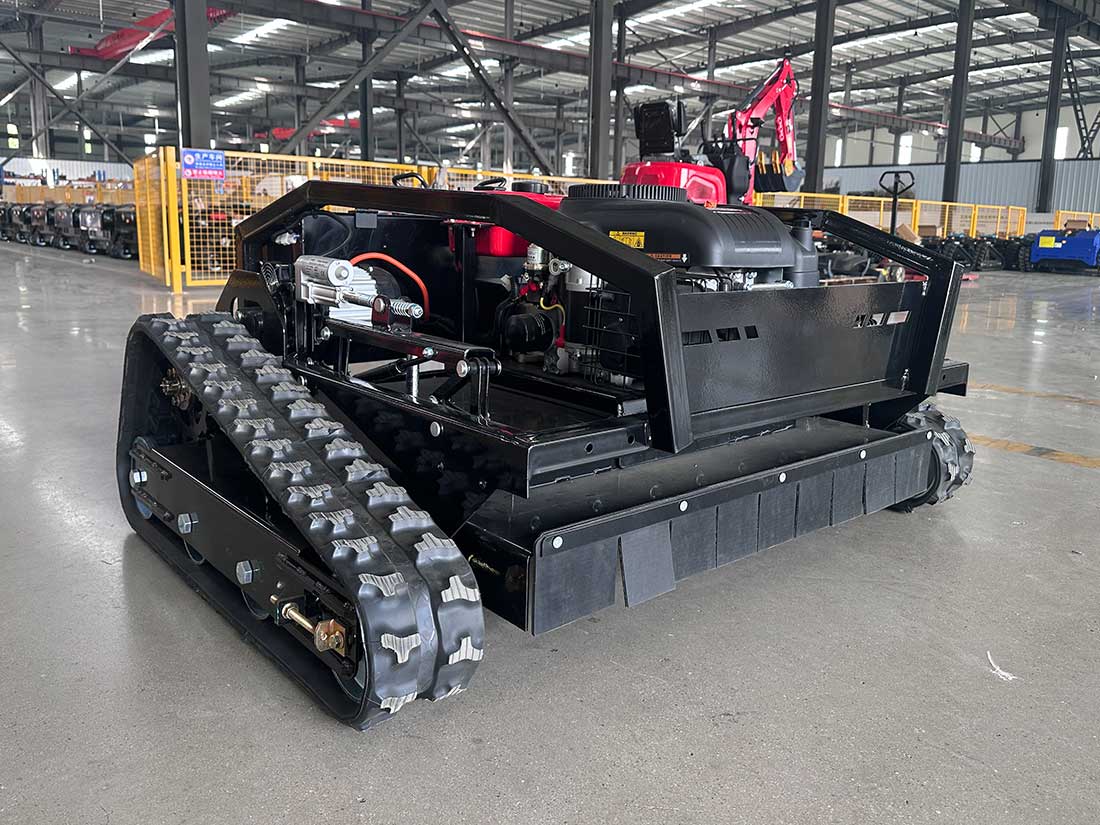
A low center of gravity and a well-engineered chassis can contribute to stability, but neither should be evaluated in isolation. Weight distribution, track geometry, deck placement, and the intended direction of travel also matter.
The contractor should verify the manufacturer's rated operating limits and avoid assuming that a machine capable of climbing a particular incline can safely work across that same incline.
Durable construction, protected components, accessible service points, and suitable weather resistance can further support reliable operation in demanding outdoor environments.
Maintenance and Serviceability
Professional equipment must remain productive over repeated operating cycles. Before purchasing a remote controlled lawn mower, inspect how easily operators can access the cutting deck, clean vegetation buildup, inspect tracks, check fasteners, and carry out routine servicing.
Important questions include:
Are replacement blades, belts, filters, and track components readily available?
Is the maintenance schedule clearly documented?
Can the machine be transported and stored conveniently?
Does the supplier provide technical support and operator training?
Are spare parts and service procedures appropriate for the expected workload?
These practical considerations can be as important as initial purchase price when calculating long-term operating costs.
4. Comparing Remote Controlled and Traditional Mowing Equipment
Traditional lawn mowers remain effective for many flat, accessible lawns. They can be economical for routine residential maintenance and familiar to operators who already have the necessary equipment.
A remote controlled lawn mower, however, may be better suited to jobs where remote operation, specialized traction, or access to difficult terrain offers a meaningful operational advantage.
| Evaluation factor | Remote controlled lawn mower | Traditional mower |
|---|---|---|
| Steep or hazardous areas | Can reduce the need for the operator to stand directly on the mowing surface, subject to machine limits | May require more direct operator access to the working area |
| Rough terrain | Specialized tracked models may offer improved traction on suitable surfaces | Performance depends on wheel design, traction, clearance, and terrain |
| Operator positioning | Allows operation from a separate location within approved control conditions | Usually requires the operator to ride on or walk behind the machine |
| Dense vegetation | Performance depends on power, deck design, and machine specifications | Performance varies with mower type and cutting capacity |
| Initial investment | Specialized models may have a higher purchase price | Basic models may be less expensive |
| Training and maintenance | Requires knowledge of remote controls, safety systems, and specialized components | Depends on the mower type and operating method |
The comparison shows why equipment selection should be task-specific. Not every site needs a remote controlled lawn mower, but difficult slopes, inaccessible vegetation, and certain commercial maintenance requirements can justify evaluating one.
5. Testing the Machine Before Purchase
A professional equipment decision should be supported by practical testing whenever possible. Product specifications are useful, but a controlled demonstration can reveal how the machine behaves under representative working conditions.
For the contractor in this illustrative scenario, a trial would include the following stages.
Test on Representative Ground
Begin on a level, open section to check the controls, braking or stopping behavior, cutting consistency, and maneuverability. Move to more challenging ground only after confirming that the machine and operator are ready.
Any incline testing must remain within the manufacturer's documented limits and follow its recommended procedures. Do not test maximum slopes simply to see whether the machine can manage them.
Evaluate Cutting Quality
Inspect the result for missed strips, uneven cutting height, vegetation wrapping around moving components, and signs that the machine is being overloaded.
Record the conditions of each trial, including grass height, moisture, cutting-height setting, and operating speed. This helps ensure that comparisons between machines are meaningful.
Measure Practical Productivity
Instead of judging productivity by cutting width alone, measure the area maintained per hour under comparable conditions. Account for turning, repositioning, obstacle avoidance, refueling or charging, cleaning, and routine adjustments.
A remote controlled lawn mower may reduce the time required for some difficult jobs, but actual productivity depends on site layout, vegetation, operator experience, and the machine's capabilities.
Check Safety and Usability
Operators should assess control responsiveness, visibility, emergency-stop access, and ease of transporting the machine to the worksite. Confirm that safety instructions are understandable and that training is available where required.
A machine that is powerful but difficult to control consistently may not be the most suitable choice for a professional team.
6. Calculating the Total Cost of Ownership
The purchase price is only one part of the investment. A realistic evaluation of a remote controlled lawn mower should include the costs associated with ownership and operation over its expected service life.
Common cost categories include:
Initial equipment purchase and delivery.
Fuel or electricity, depending on the power system.
Blades, filters, belts, tracks, and other wear components.
Routine servicing and repairs.
Operator training and transportation.
Downtime and access requirements.
Equipment storage and end-of-life value.
Potential benefits should also be measured carefully. Depending on the application, a remote controlled lawn mower may reduce the need for manual work in hazardous positions, improve access to certain areas, or reduce the time needed for vegetation maintenance.
To estimate the financial impact, compare the current method with the proposed machine using the same workload and cost assumptions.
For example, calculate the annual labor and maintenance costs of the existing approach, then estimate the corresponding costs for the remote controlled lawn mower. Include financing or depreciation where relevant, and use realistic productivity figures from a site trial rather than unsupported manufacturer claims.
The resulting comparison will provide a stronger basis for deciding whether the investment is commercially justified.
7. Professional Safety Practices for Difficult Terrain
Remote control can improve operator positioning, but it does not remove the hazards associated with mowing steep slopes, rough ground, or heavy vegetation.
A responsible operating plan should include the following measures:
Conduct a risk assessment. Identify slope hazards, unstable soil, hidden obstacles, nearby roads, bystanders, and overhead or underground hazards where relevant.
Follow the manufacturer's operating limits. Confirm maximum gradients, permitted travel directions, ground conditions, and any restrictions on wet or slippery surfaces.
Establish an exclusion zone. Keep people and animals away from the machine and its cutting area, following the required safety distances.
Inspect the machine before use. Check the tracks or wheels, cutting components, guards, control system, and emergency-stop function.
Maintain a suitable operating position. Choose a stable location with adequate visibility and a safe escape route, as specified by the operating procedure.
Stop when conditions become unsafe. Avoid operation when traction, visibility, communications, or ground stability are inadequate.
Provide appropriate training. Operators should understand machine controls, emergency procedures, inspection requirements, and site-specific hazards.
These practices are essential when using a remote controlled lawn mower for commercial landscaping, roadside vegetation, embankments, and other challenging environments.
8. What the Case Study Teaches Equipment Buyers
The illustrative contractor scenario highlights several lessons that apply to professional vegetation management.
First, start with the site rather than the machine. Documenting slopes, vegetation, obstacles, and access constraints makes it easier to define the required specifications.
Second, prioritize verified capability over headline figures. A high-power engine, wide deck, or impressive advertised gradient does not independently prove that a remote controlled lawn mower will perform safely and consistently on a particular site.
Third, evaluate the whole operating system. Cutting performance, traction, controls, maintenance, spare parts, and operator training all influence long-term results.
Fourth, use comparable trial data. Measuring productivity and cutting quality under representative conditions provides a more reliable basis for selection than relying on general claims.
Finally, consider the supplier's technical support. Professional users benefit from clear specifications, maintenance guidance, parts availability, and assistance with choosing equipment for the intended application.
9. Explore Professional Remote-Controlled Mowing Equipment from JY Lawn Mower
For businesses seeking equipment for difficult terrain, comparing specialized remote-controlled mowing solutions is a practical next step. The appropriate machine will depend on the worksite's slope, vegetation, operating frequency, access conditions, and maintenance requirements.
Visit https://www.jylawnmower.com/ to explore JY Lawn Mower's remote-controlled mowing equipment and learn more about potential solutions for professional vegetation management.
When evaluating products, ask for specifications that match your intended use, including the rated working gradient, cutting system, power output, control range, safety features, maintenance requirements, and available after-sales support. Confirm that any advertised performance is suitable for your actual operating conditions.
A well-selected remote controlled lawn mower can be a valuable addition to a professional fleet when its capabilities align with the worksite and its use is supported by appropriate training and safety procedures.
Conclusion
Choosing the best remote controlled lawn mower for difficult terrain requires a structured approach that combines site assessment, technical evaluation, practical testing, cost analysis, and safety planning.
Steep embankments, uneven ground, dense vegetation, and restricted access each create different challenges. By evaluating traction, cutting capacity, stability, control reliability, serviceability, and total ownership cost, professional buyers can identify equipment that fits their operational requirements.
The central lesson of this case study is simple: the best machine is not necessarily the most powerful or the most expensive. It is the one that delivers reliable cutting performance within its documented operating limits while supporting safe, efficient, and maintainable work.
For further information about remote-controlled mowing equipment and potential solutions for challenging outdoor environments, visit JY Lawn Mower and compare the available options against your site's specific requirements.