 English
 Spanish
 Portuguese
 French
 Italian
 Remote Mower
Uneven terrain is one of the biggest challenges in professional vegetation management. Steep slopes, rough grassland, embankments, orchards, roadside areas, and irregular fields can make conventional mowing slower, more difficult, and potentially more demanding for operators.
For professional landscapers, agricultural contractors, municipalities, and vegetation-management companies, the right equipment needs to do more than cut grass. It must provide reliable traction, controlled movement, effective cutting performance, and a safer operating method.
This is where the remote controlled lawn mower has become an increasingly valuable solution.
A modern remote controlled lawn mower combines remote operation with professional mowing technology, allowing operators to control the machine from a suitable distance. When combined with crawler-track mobility and a robust cutting system, it can be particularly useful for challenging terrain where conventional lawn mowers may not be the most practical choice.
Why Uneven Terrain Is Difficult to Mow
Uneven terrain creates several operational challenges that are rarely encountered on a flat residential lawn.
Professional mowing teams may encounter:
Steep slopes
Uneven ground
Loose soil
Tall and dense grass
Stones and other obstacles
Ditches and drainage channels
Orchard rows
Roadside embankments
Areas with limited machine access
On this type of terrain, machine stability and traction become just as important as cutting performance.
A remote controlled lawn mower is designed around a different operating concept. Instead of requiring the operator to ride on or walk directly behind the machine, remote control allows the operator to manage the mower from a more suitable observation position.
This can make remote-controlled mowing equipment particularly attractive for professional applications involving difficult terrain.
How a Remote Controlled Lawn Mower Works
The basic principle is straightforward.
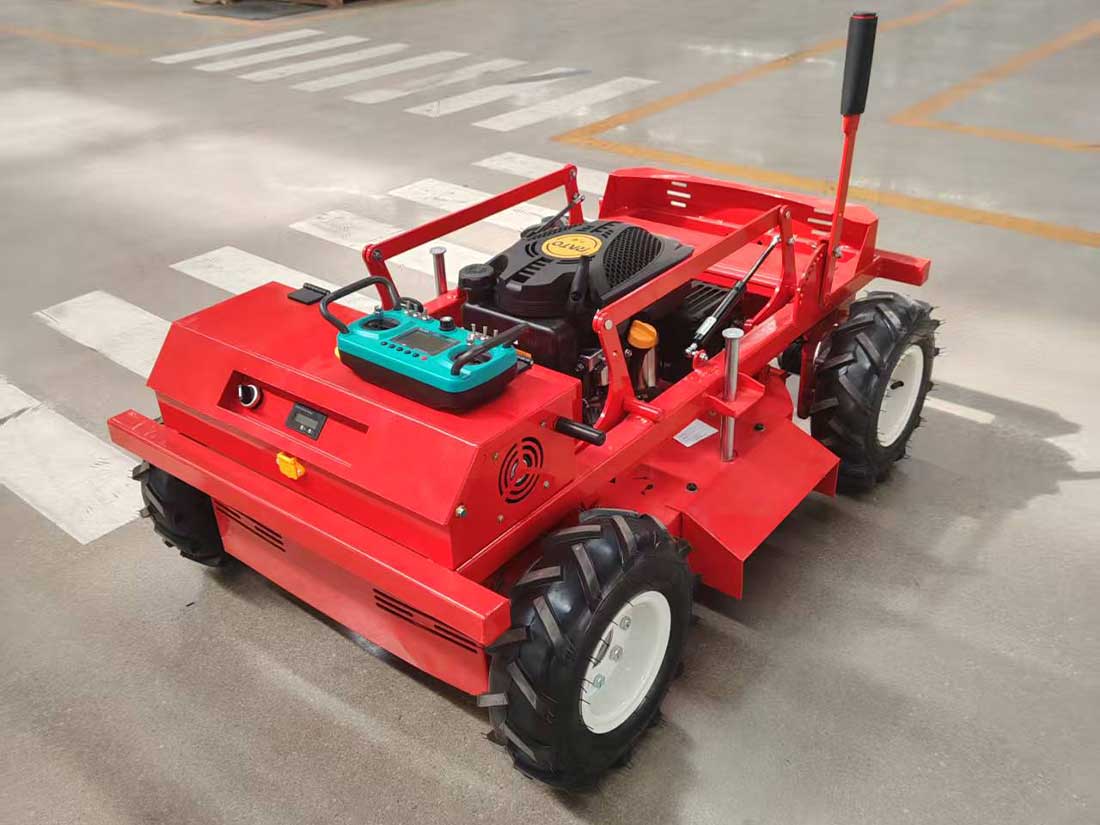
The operator uses a remote-control transmitter to manage the remote controlled lawn mower while maintaining visual contact with the machine.
Depending on the machine configuration, remote controls may operate functions such as:
Forward and reverse travel
Steering
Travel speed
Cutting engagement
Direction changes
Machine positioning
Emergency stop functions
The exact controls vary between manufacturers and models.
The important difference is that the operator does not necessarily need to remain immediately beside the machine while it is cutting.
This separation can be particularly useful when the remote controlled lawn mower is operating on a slope, near an embankment, or in an area where direct access is inconvenient.
Remote operation should always be combined with appropriate training, terrain assessment, safe operating distances, and compliance with the manufacturer's operating limits.
Crawler Tracks Make a Difference
Remote control alone does not make a mower suitable for uneven terrain.
The machine's mobility system is equally important.
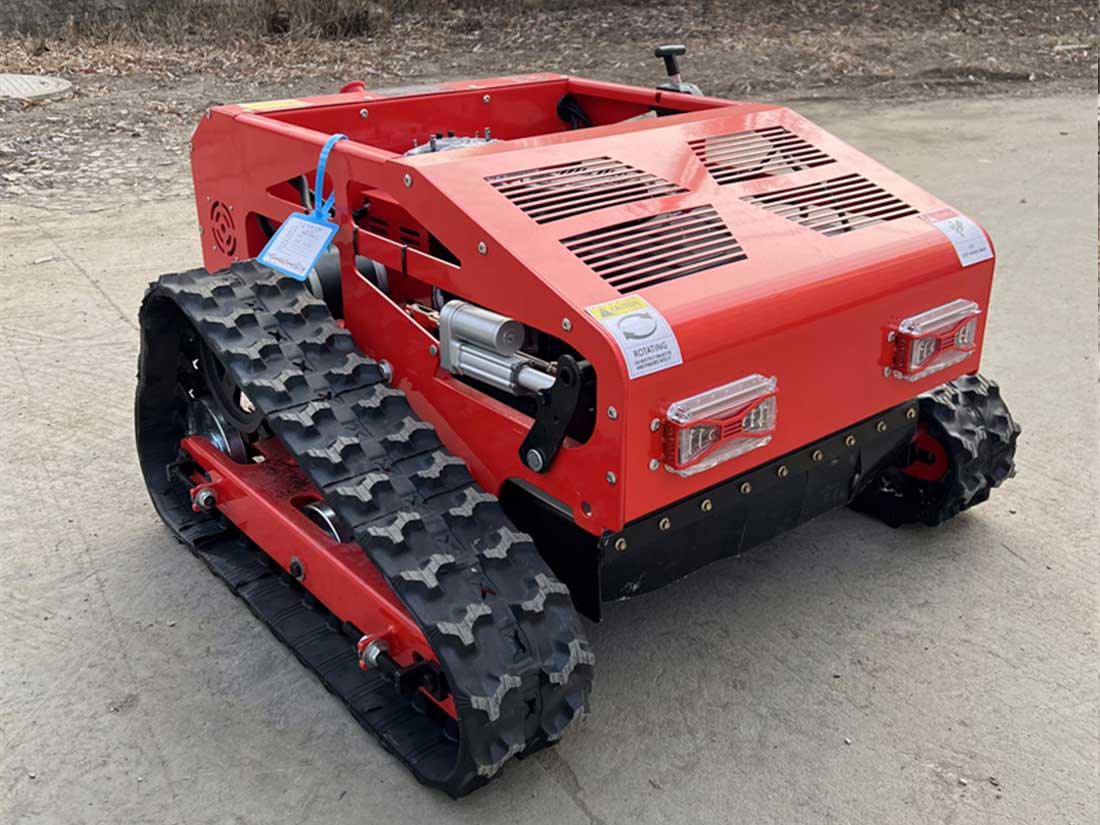
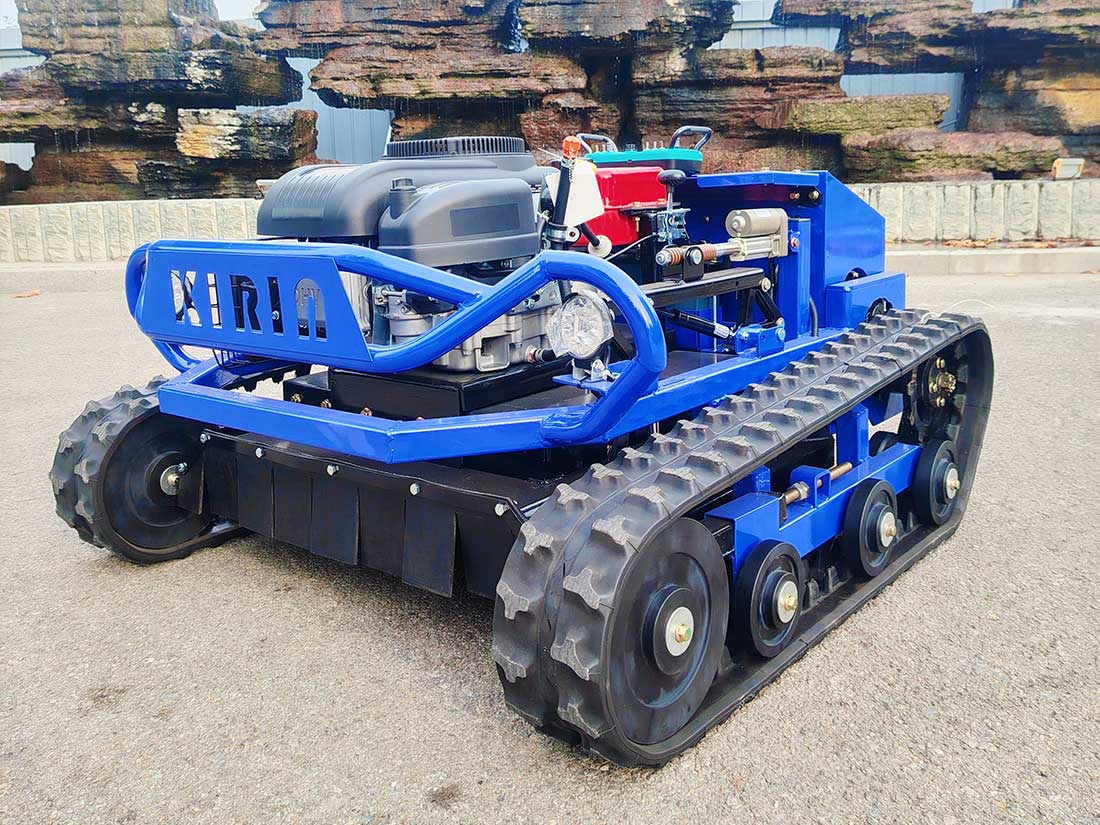
A tracked remote controlled lawn mower can provide advantages on suitable rough or uneven surfaces because crawler tracks distribute contact with the ground across a larger area.
This can help provide traction and controlled movement when the machine encounters irregular terrain.
For professional mowing applications, crawler mobility can be particularly useful for:
Hillsides
Rough grassland
Agricultural fields
Orchards
Roadside slopes
Embankments
Parks with irregular terrain
However, professional operators should always check the manufacturer's specifications for maximum operating slopes, ground conditions, and machine limitations.
A remote controlled lawn mower should never be selected solely because it has tracks. The complete machine configuration needs to match the intended application.
Improved Safety on Slopes
One of the strongest reasons to consider a remote controlled lawn mower is operator positioning.
Slopes can create difficult working conditions. Walking across uneven ground while operating mowing equipment can increase physical demands and make it harder to maintain a stable position.
With remote-controlled mowing equipment, the operator can control the machine from an appropriate location rather than following it directly across every part of the slope.
This can provide several practical advantages:
Greater operator separation: The operator can remain away from the immediate cutting area.
Better visibility: The operator can select a position that provides a clear view of the machine and surrounding terrain.
More controlled movement: Travel speed and direction can be adjusted according to changing conditions.
Faster response: The operator can stop the machine when an obstacle or unexpected condition appears.
A remote controlled lawn mower does not eliminate hazards, but it can change the relationship between the operator and the machine in a way that supports safer professional mowing procedures.
Better Control on Irregular Ground
Uneven terrain requires constant adjustment.
A machine may move from firm ground to soft soil, from level grass to a slope, or from open space to an area containing trees and obstacles.
A professional remote controlled lawn mower allows the operator to make these adjustments while maintaining a clear view of the working area.
For experienced operators, this can be especially valuable when navigating:
Tree-lined properties
Orchard rows
Drainage channels
Rough fields
Narrow passages
Roadside vegetation
Sloped landscapes
The operator can slow the machine when necessary, change direction, and stop the cutting operation when conditions require further inspection.
This level of control is one of the key differences between specialized remote-controlled mowing equipment and conventional lawn-care machinery.
Remote Controlled Lawn Mower for Landscaping
Professional landscaping is one of the most important application areas for a remote controlled lawn mower.
Large parks, estates, commercial properties, public green spaces, and recreational areas often contain a mixture of maintained lawns and difficult terrain.
A conventional mower may work efficiently in open flat areas but become less practical when the property includes slopes, rough grass, or restricted-access sections.
A remote controlled lawn mower can provide an additional equipment option for these difficult sections.
For landscaping contractors, this can help create a more flexible equipment strategy:
Use appropriate equipment for flat, maintained lawns.
Use remote-controlled mowing equipment for slopes and rough areas.
Select the cutting system according to vegetation conditions.
Organize mowing routes according to terrain.
Maintain equipment according to professional service schedules.
This approach allows contractors to match equipment to the actual conditions of each property.
Agriculture and Orchard Applications
Agricultural land often presents naturally uneven terrain.
Fields can contain slopes, rough grass, drainage areas, vegetation around trees, and sections that are difficult to access with larger conventional equipment.
A remote controlled lawn mower can be useful for vegetation management in these areas, particularly when maneuverability and operator positioning are important.
Orchards are another potential application.
Trees and narrow working areas can require careful machine positioning. Remote operation allows the operator to remain in a suitable location while controlling the machine around obstacles.
For agricultural contractors, equipment versatility is an important consideration. A remote controlled lawn mower capable of handling multiple vegetation-management tasks may provide greater value than a machine designed for only one type of environment.
Roadside and Embankment Maintenance
Roadside maintenance presents another challenging application.
Roadside slopes, drainage channels, and embankments can be difficult to mow using conventional equipment. Professional operators also need to consider surrounding traffic, infrastructure, visibility, and changing ground conditions.
A remote controlled lawn mower can help address some of these challenges by allowing the operator to control the mowing machine remotely.
Professional mowing equipment is widely associated with landscaping, agriculture, and roadside maintenance applications, making these important areas for modern vegetation-management technology.
For contractors working on roadside vegetation, the combination of crawler mobility and remote operation can provide a practical approach to difficult mowing areas.
Choosing the Right Cutting System
A remote controlled lawn mower needs an appropriate cutting system for the vegetation being managed.
Not every mowing project involves the same type of grass.
A property may contain short maintained turf in one area and tall, dense vegetation in another.
Professional buyers should therefore consider:
Grass height
Vegetation density
Weed growth
Brush conditions
Required cutting finish
Working speed
Terrain
Maintenance frequency
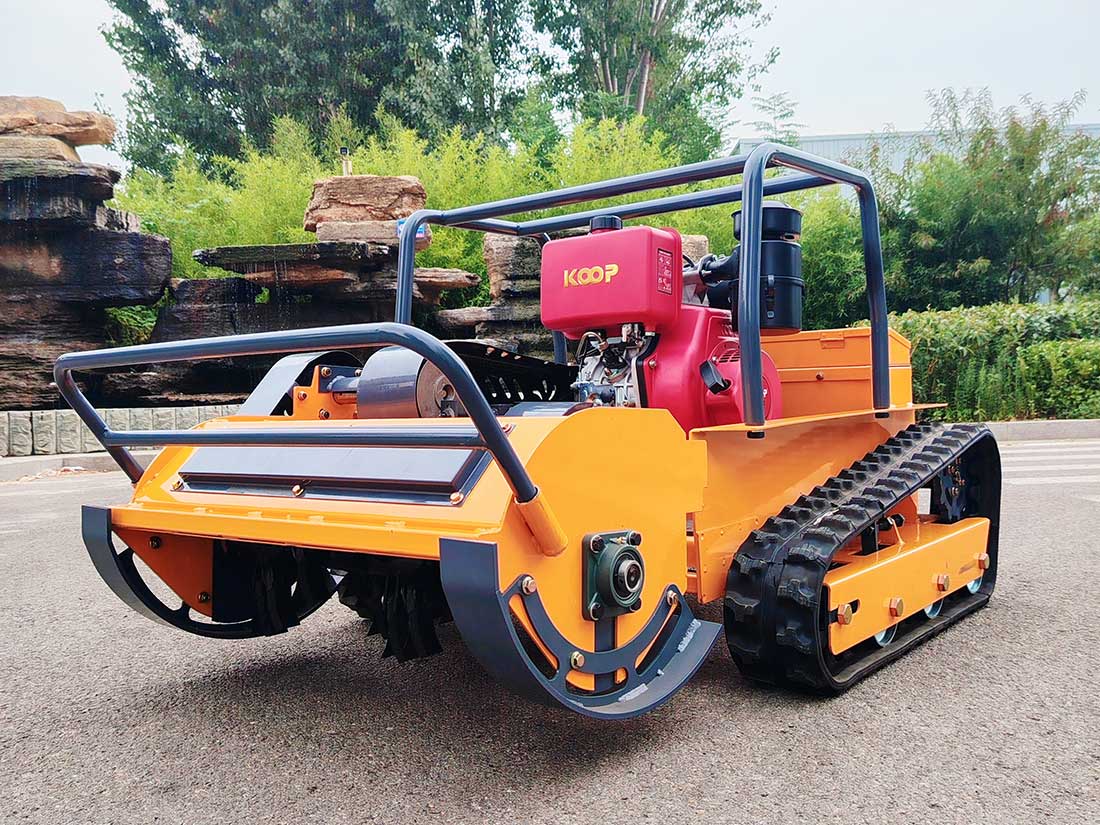
Rotary cutting systems can be suitable for many general grass-cutting applications, while flail-style systems can be considered for heavier vegetation and rougher mowing conditions.
The correct configuration depends on the specific application.
This is why experienced buyers evaluate the entire remote controlled lawn mower, rather than focusing only on horsepower or cutting width.
Productivity on Large and Difficult Areas
Uneven terrain can significantly increase mowing time.
Operators may need to slow down, reposition equipment, avoid obstacles, or make additional passes to achieve the required result.
A remote controlled lawn mower can help create a more systematic workflow.
For large properties, operators can divide the area into zones according to terrain and vegetation.
For example:
Zone 1: Flat Open Areas
Use a suitable high-productivity configuration for efficient coverage.
Zone 2: Slopes
Deploy the remote controlled lawn mower while maintaining an appropriate operator position.
Zone 3: Rough Vegetation
Use a cutting system appropriate for dense or heavy vegetation.
Zone 4: Restricted Areas
Use the machine's maneuverability and remote control to access areas where conventional equipment may be less convenient.
This zone-based approach can help professional teams manage large properties more efficiently.
What Professionals Should Consider Before Buying
The best remote controlled lawn mower is not necessarily the most powerful machine.
Professional buyers should evaluate the complete working environment.
Terrain Capability
Check the machine's permitted slope and terrain conditions.
Traction
Evaluate whether the track system is suitable for the ground conditions encountered during normal operation.
Cutting Width
A wider deck may improve productivity in open areas, while a narrower machine may be easier to maneuver in restricted spaces.
Cutting System
Match the cutting mechanism to the vegetation.
Remote-Control Functionality
The control system should provide accurate and intuitive management of machine movement and mowing functions.
Maintenance
Check how easily operators can access components that require regular inspection and service.
Parts and Support
For commercial applications, long-term technical support and spare-parts availability should be considered as part of the purchase decision.
These factors are often more important than a single headline specification.
Maintenance for Reliable Operation
A professional remote controlled lawn mower should be treated as a long-term working asset.
Before operation, operators should inspect the cutting system, tracks, drive components, fasteners, safety systems, and other relevant components.
After mowing, grass and debris should be removed from areas where accumulation could affect machine performance.
Cutting components should be inspected regularly for wear or damage.
For machines equipped with hydraulic systems, the relevant hydraulic components and connections should also be inspected according to the manufacturer's maintenance schedule.
The remote-control system should be checked and maintained according to manufacturer recommendations.
Preventive maintenance helps reduce unexpected downtime and supports consistent performance.
Why Remote-Controlled Mowing Is Becoming More Important
The growth of the remote controlled lawn mower reflects a broader change in professional vegetation management.
Modern contractors are looking for equipment that can address several challenges simultaneously:
Difficult terrain
Operator safety
Labor efficiency
Large working areas
Dense vegetation
Limited-access locations
Remote-controlled mowing equipment addresses these requirements by changing how the operator interacts with the machine.
Instead of placing the operator directly on or beside the mower, the technology allows the operator to control the machine remotely.
Combined with tracked mobility and professional cutting systems, the remote controlled lawn mower becomes a specialized solution for challenging vegetation-management environments.
The Future of Uneven-Terrain Mowing
As professional landscaping and vegetation management become increasingly technology-driven, remote-controlled equipment is likely to play a larger role.
The future of mowing is not simply about making machines more powerful.
It is about making them more adaptable.
A modern remote controlled lawn mower can combine:
Remote operation
Tracked mobility
Professional cutting capability
Precise machine control
Terrain adaptability
Operator-focused safety
Versatile applications
This combination can make remote-controlled mowing equipment especially valuable for contractors responsible for large landscapes and difficult terrain.
Conclusion
Uneven terrain requires a different approach to professional mowing.
Slopes, rough fields, orchards, roadside embankments, drainage areas, and irregular landscapes can create challenges that conventional lawn mowers are not always designed to address.
A remote controlled lawn mower provides an alternative by combining remote operation with professional mowing technology and, in suitable configurations, crawler-track mobility.
The most important benefits include improved operator positioning, greater control, terrain adaptability, professional cutting performance, and greater flexibility across landscaping, agriculture, and roadside maintenance.
However, selecting the right remote controlled lawn mower requires more than looking at a single specification. Terrain capability, cutting system, machine stability, remote-control functionality, maintenance requirements, and long-term support should all be evaluated.
For businesses looking for professional remote-controlled mowing equipment for uneven terrain, slopes, large landscapes, agriculture, orchards, or roadside vegetation, explore the solutions available from JY Lawn Mower at JY Lawn Mower.