 English
 Spanish
 Portuguese
 French
 Italian
 Remote Mower
As solar energy continues to expand, the maintenance of photovoltaic sites has become an increasingly important part of solar farm operations. Solar panels require adequate clearance from surrounding vegetation, while large sites can contain uneven ground, narrow corridors, slopes, and areas that are difficult to access with conventional machinery.
In this environment, the remote controlled mower is emerging as a practical solution for professional vegetation management. By combining remote operation, robust traction, and specialized cutting systems, modern remote-controlled mowing equipment can help maintenance teams manage grass and vegetation across large solar installations more efficiently.
For solar farm operators, contractors, and land managers, understanding how a remote controlled mower fits into solar-site maintenance is essential when evaluating modern mowing strategies.
Why Vegetation Control Matters on Solar Farms
Solar farms often cover large areas of land. Grass and weeds can grow beneath and between solar panel arrays, around access roads, and along site boundaries.
If vegetation becomes excessive, it can:
- Obstruct maintenance access;
- Make inspections more difficult;
- Increase the amount of manual vegetation work;
- Create additional fire-management concerns depending on local conditions;
- Interfere with routine site maintenance.
A suitable remote controlled mower can help maintenance crews control vegetation while reducing the need for operators to work directly behind or beside heavy mowing machinery.
Vegetation management should always follow the solar site's maintenance plan, local regulations, and the recommendations of the solar installation operator.
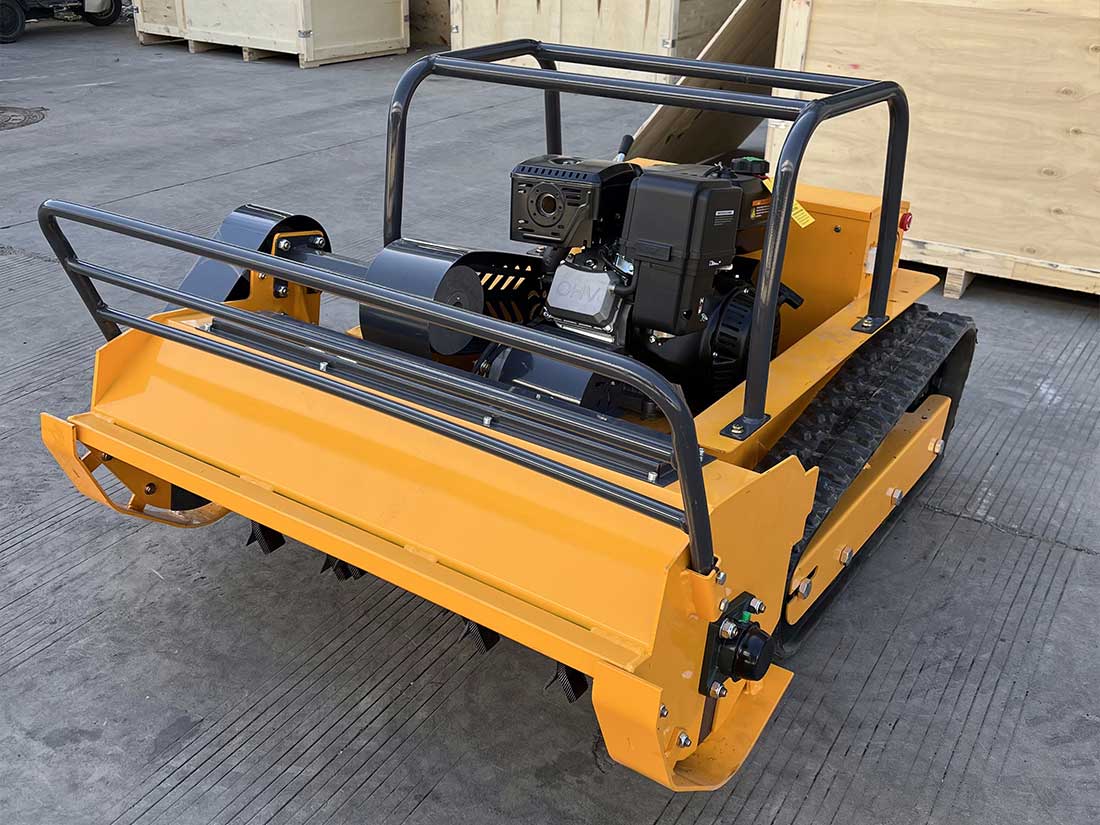
What Is a Remote Controlled Mower?
A remote controlled mower is a mowing machine operated wirelessly through a handheld controller rather than directly from a conventional driver's seat.
Depending on the model, the operator can control:
- Forward and reverse movement;
- Steering;
- Travel speed;
- Cutting operation;
- Machine positioning;
- Emergency stopping.
This operating method makes remote-controlled mowing equipment particularly interesting for solar farms because operators can maintain greater separation from the machine while monitoring its position between or around solar arrays.
Why Solar Farms Are Considering Remote-Controlled Mowing Equipment
Solar farms present a unique mowing environment.
The site may contain thousands of solar panels, support structures, electrical equipment, fencing, drainage features, and service roads. A conventional tractor or ride-on mower may not always be the most maneuverable solution.
A remote controlled mower can offer greater flexibility in areas where compact dimensions and precise maneuverability are important.
Remote-controlled equipment can be particularly useful for:
- Narrow mowing corridors;
- Uneven ground;
- Sloped areas;
- Areas around infrastructure;
- Overgrown grass;
- Large open spaces requiring repeated maintenance.
The exact suitability depends on the mower's dimensions, cutting width, turning capability, slope rating, and the layout of the solar site.
Working Around Solar Panels
One of the biggest considerations when using a remote controlled mower on a solar farm is protecting the solar infrastructure.
The machine must be selected and operated so that it does not damage panel frames, cables, mounting structures, or other site equipment.
Professional operators should pay attention to:
Machine Width
The mower must fit comfortably within the available mowing corridors.
Turning Radius
Good maneuverability is important when moving around panel rows and other obstacles.
Cutting Height
The cutting height should be appropriate for the vegetation-management requirements of the site.
Operator Visibility
The remote operator should have a clear view of the machine and surrounding infrastructure.
Debris Management
The mowing strategy should minimize the risk of debris being thrown toward solar panels or other sensitive equipment.
These considerations make equipment selection and operator training particularly important.
Handling Uneven Solar Farm Terrain
Solar farms are not always constructed on perfectly flat land. Depending on the location, a site can contain slopes, drainage channels, uneven ground, and rough sections.
A remote controlled mower designed for difficult terrain can provide improved flexibility in these areas.
Traction is especially important. A machine operating on uneven or sloped ground needs sufficient grip and stability to maintain controlled movement.
Before selecting equipment, operators should check the manufacturer's maximum recommended slope and ensure that actual site conditions remain within those limits.
Remote Operation and Worker Efficiency
Another advantage of a remote controlled mower is the ability to operate the machine from a distance.
For large solar farms, workers may spend considerable time moving between mowing areas. Remote-controlled mowing equipment can reduce the need for an operator to physically walk behind a mower throughout the entire operation.
This can help reduce physical fatigue and make repetitive vegetation-management tasks more manageable.
However, remote operation should complement—not replace—proper site planning, risk assessment, and operator training.
Productivity Across Large Solar Sites
Solar farms can span extensive areas, making productivity a critical factor.
A remote controlled mower with an appropriate cutting width, travel speed, and operating range can help contractors organize mowing operations more efficiently.
For large sites, productivity depends on several variables:
- Cutting width;
- Grass density;
- Terrain;
- Battery or fuel capacity;
- Travel speed;
- Remote-control range;
- Frequency of mowing;
- Site layout.
There is no single machine that is ideal for every solar farm. Professional equipment selection should be based on actual site conditions.
Choosing the Right Remote Controlled Mower
When evaluating a remote controlled mower for solar farm vegetation management, buyers should look beyond engine power.
1. Cutting Width
A wider cutting width can improve productivity in open areas, while a narrower machine may be better between closely spaced panel rows.
2. Machine Dimensions
The overall width and height should be compatible with the solar array configuration.
3. Traction
Evaluate the mower's ability to operate on the site's soil and slopes.
4. Cutting System
The cutting mechanism should be appropriate for the grass and vegetation commonly found on the property.
5. Remote-Control Range
Large solar sites require sufficient communication range for practical operation.
6. Battery or Fuel System
Operating time should match the expected mowing schedule.
7. Maintenance
Check accessibility of replacement parts, routine service requirements, and technical support.
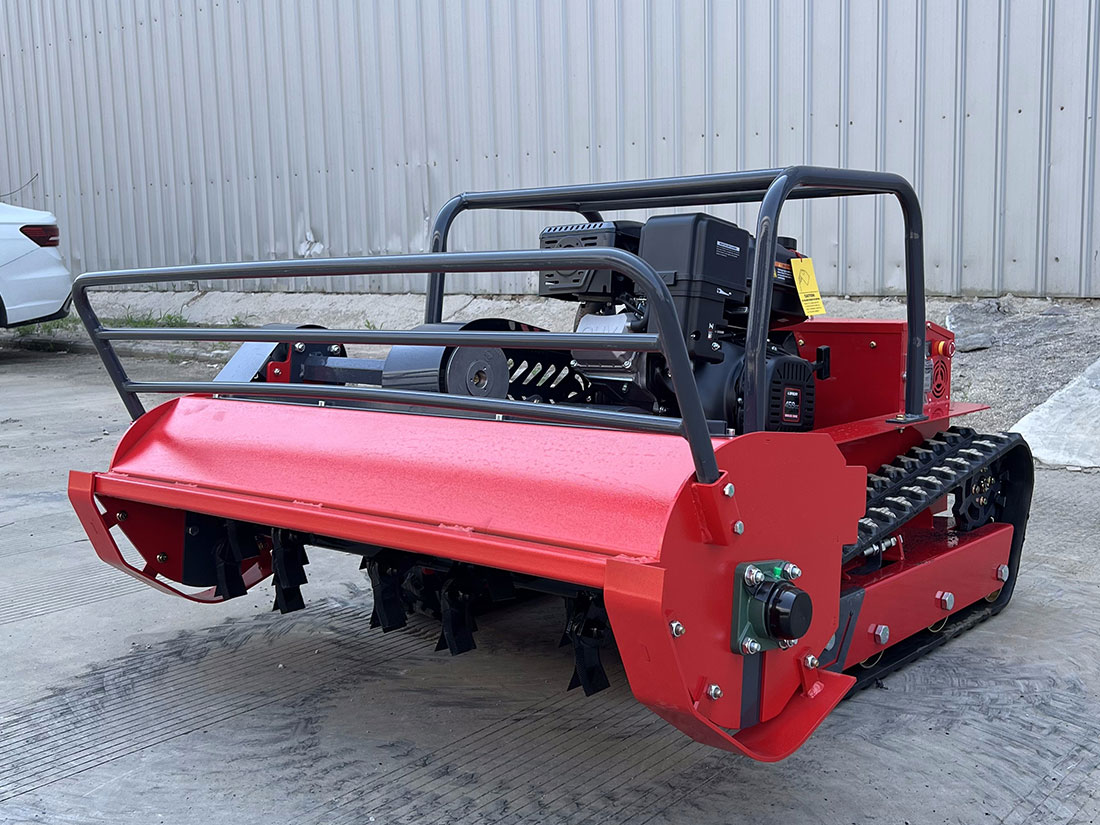
Safety Around Solar Infrastructure
Safety is particularly important when using a remote controlled mower around electrical infrastructure.
Operators should identify the location of:
- Electrical cables;
- Inverters;
- Transformers;
- Panel supports;
- Fences;
- Drainage systems;
- Access roads.
The equipment should be operated according to the solar site's safety procedures and the mower manufacturer's instructions.
A remote-controlled mower does not remove all hazards. Operators still need to maintain adequate visibility, control the machine responsibly, and stop operations if unexpected conditions arise.
Professional Maintenance Strategy
Effective solar farm vegetation management is not simply about cutting grass once. It requires a consistent maintenance strategy.
A professional program may include:
- Regular vegetation inspections;
- Scheduled mowing;
- Targeted cutting in difficult areas;
- Monitoring vegetation growth;
- Inspection of access routes;
- Equipment maintenance;
- Documentation of completed work.
Using a remote controlled mower as part of a structured maintenance program can help contractors establish a repeatable approach to large-scale vegetation control.
Maintaining the Mowing Equipment
Even a professional remote controlled mower requires regular maintenance.
After operation, technicians should inspect:
- Cutting blades;
- Tires or tracks;
- Drive components;
- Battery or fuel system;
- Remote-control equipment;
- Electrical connections;
- Chassis;
- Fasteners and structural components.
Grass, dust, and mud should be cleaned according to the manufacturer's recommendations.
Preventive maintenance can help reduce downtime and preserve equipment performance over the long term.
Why Manufacturer Experience Matters
Developing reliable remote-controlled mowing equipment requires expertise in mechanical engineering, power systems, drivetrain design, cutting technology, and wireless control.
For solar farm applications, the equipment must also provide an appropriate balance between maneuverability, cutting performance, durability, and operational control.
This is why solar farm operators should consider the manufacturer's technical experience, product design, support capabilities, and intended applications when selecting a remote controlled mower.
Explore Professional Remote-Controlled Mowing Equipment
For companies looking for specialized machinery for solar farms and other challenging vegetation-management applications, professional remote-controlled equipment can be an important investment.
JY Lawn Mower provides remote-controlled mowing solutions designed for professional vegetation management and difficult terrain.
JY Lawn Mower — Professional Remote-Controlled Mowing Equipment
The website provides an opportunity to explore equipment designed for demanding mowing applications and learn more about solutions that may be suitable for large-scale land management.
The Future of Solar Farm Vegetation Management
The solar industry is growing, and efficient land management will become increasingly important as more photovoltaic installations are developed.
The remote controlled mower is part of a broader trend toward smarter and more specialized vegetation-management equipment.
Future remote-controlled mowing equipment may incorporate:
- Improved wireless control;
- Advanced sensors;
- Better obstacle detection;
- Enhanced navigation;
- Remote monitoring;
- Improved energy efficiency;
- More sophisticated safety systems.
These developments could make vegetation management more precise and productive while reducing the physical demands placed on maintenance teams.
Conclusion
Solar farm vegetation control requires equipment that can operate efficiently around valuable infrastructure while handling large areas and varied terrain.
A remote controlled mower can provide a practical combination of maneuverability, remote operation, cutting performance, and productivity for suitable solar farm applications.
The right choice depends on the site's layout, vegetation, terrain, panel spacing, required cutting height, operating conditions, and maintenance schedule. Professional assessment should always come before equipment selection.
As remote-controlled mowing equipment continues to develop, the remote controlled mower is positioned to become an increasingly valuable tool for efficient vegetation management across solar farms and other large-scale properties.
For more information about professional remote-controlled mowing solutions, visit:
https://www.jylawnmower.com/ — JY Lawn Mower