 English
 Spanish
 Portuguese
 French
 Italian
 Remote Mower
The landscaping industry is evolving rapidly as property owners, landscaping contractors, and maintenance professionals seek safer, more efficient, and more reliable ways to manage outdoor spaces. Traditional mowing equipment remains useful for many applications, but challenging terrain, labor-intensive maintenance, and increasingly demanding project schedules have encouraged professionals to explore smarter alternatives. One innovation attracting growing attention is the remote controlled lawn mower.
Designed to give operators greater control over mowing operations, a remote controlled lawn mower can help tackle steep slopes, uneven ground, roadside vegetation, orchards, and other areas where conventional mowing methods may be difficult or risky. By combining remote operation with specialized cutting systems and compact, maneuverable designs, this equipment is changing how landscaping professionals approach demanding maintenance tasks.
For businesses looking to improve productivity while maintaining high safety standards, understanding the advantages of remote-controlled mowing equipment is an important step toward making informed equipment investments.

1. Why Modern Landscaping Needs Smarter Mowing Solutions
Landscaping is no longer limited to maintaining small residential lawns. Professional teams increasingly manage commercial properties, public green spaces, solar farms, roadside embankments, agricultural land, and large estates. Each environment presents different operational challenges.
A traditional lawn mower may perform well on flat, accessible grass, but steep inclines, dense vegetation, and irregular ground can increase operating difficulty. In some situations, workers must spend additional time positioning equipment, trimming inaccessible areas, or completing tasks manually.
A remote controlled lawn mower offers an alternative by allowing an operator to control the machine from a more suitable position. Depending on the model and its specifications, this can improve access to difficult areas while reducing the need for an operator to walk directly behind or ride on the machine.
The benefits of a remote controlled lawn mower are particularly relevant for landscaping businesses that regularly encounter:
Steep slopes and embankments.
Uneven ground and rough terrain.
Tall grass and dense vegetation.
Large areas requiring repeated mowing.
Restricted spaces where maneuverability is essential.
Rather than replacing every conventional mower, remote-controlled mowing equipment provides another specialized solution for jobs where terrain, accessibility, and operator positioning are important considerations.
2. Improved Operator Safety on Challenging Terrain
Safety is one of the most important considerations when selecting professional mowing equipment. Sloped ground, loose soil, wet grass, and unexpected obstacles can create challenging operating conditions, especially when conventional machines are difficult to stabilize.
A remote controlled lawn mower allows the operator to control mowing movements from outside the machine. On suitable models, this arrangement can reduce direct exposure to certain hazards associated with walking on steep slopes or operating equipment from an onboard position.
Remote operation does not eliminate all risks. Machine stability, traction, slope ratings, visibility, emergency-stop functions, and the manufacturer's operating instructions remain essential factors when choosing equipment.
For professional landscaping teams, the right remote controlled lawn mower should therefore be evaluated not only by its cutting performance but also by its safety systems and suitability for the intended working environment.
Before purchasing, contractors should review the machine's maximum permitted slope, ground-clearance requirements, track design, braking performance, and emergency shutdown features. Operators should also receive appropriate training and follow site-specific safety procedures.
When properly selected and operated, remote-controlled mowing equipment can provide a practical way to manage certain difficult mowing tasks while improving how workers position themselves during operations.
3. Greater Efficiency and Productivity for Landscaping Businesses
Time management is essential for landscaping contractors working across multiple properties. Delays caused by difficult access, frequent equipment repositioning, and labor-intensive vegetation clearing can affect project schedules and operating costs.
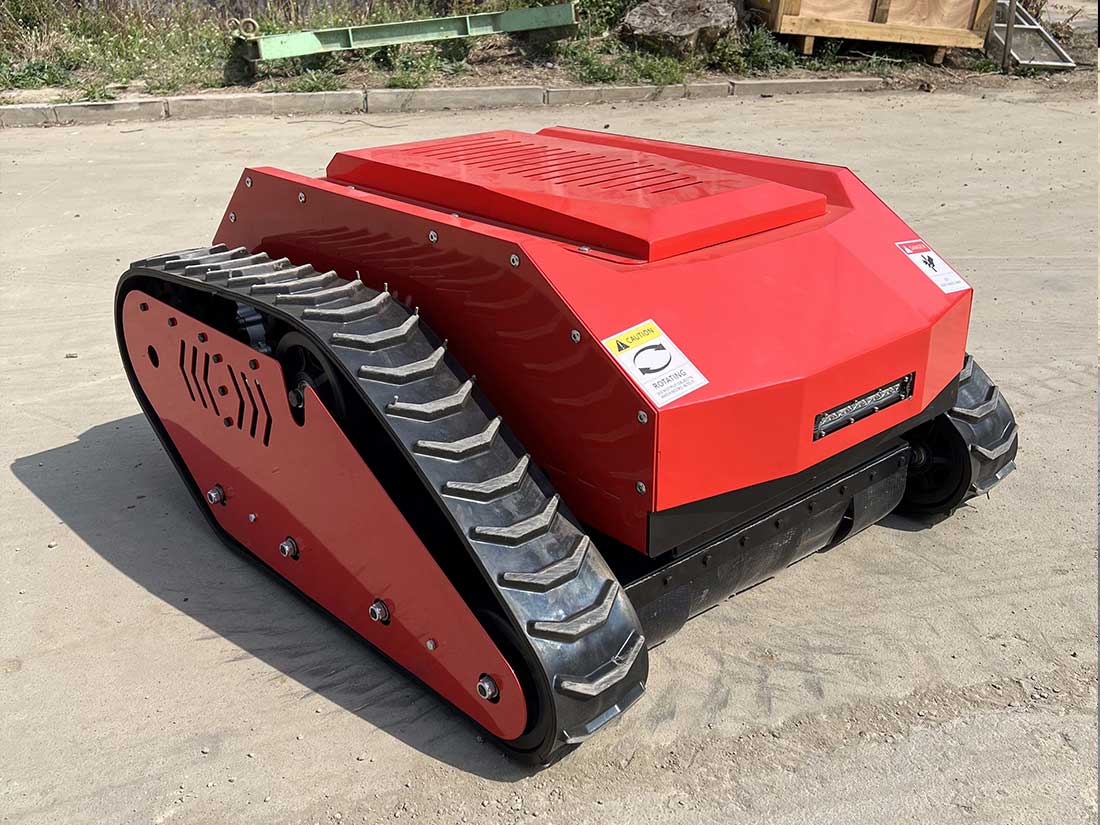
A remote controlled lawn mower can help simplify these operations by allowing an operator to guide the machine through challenging areas while maintaining control over its movement and cutting performance.
For example, consider a contractor responsible for maintaining a commercial property with open lawns, drainage channels, and steep grass-covered banks. A conventional mower may handle the open lawn efficiently, while the banks require additional equipment and careful manual work. Introducing a suitable remote controlled lawn mower for the difficult sections can help the contractor organize the work more effectively.
Potential productivity advantages include:
Reduced manual trimming: Suitable mowing tasks may be completed mechanically rather than relying entirely on handheld brush cutters.
More flexible equipment deployment: Compact remote-controlled machines can access certain narrow or uneven areas that larger equipment cannot easily reach.
Better task planning: Contractors can assign specialized machines to difficult sections while conventional mowers maintain open lawns.
More consistent maintenance routines: Repeatable operating procedures can help teams plan recurring vegetation management.
However, actual productivity depends on cutting width, terrain, vegetation density, travel speed, operator experience, and setup time. Businesses should evaluate real working conditions rather than assume that every remote controlled lawn mower will automatically outperform traditional equipment.
4. Better Performance on Slopes and Uneven Ground
One of the strongest applications for remote-controlled mowing equipment is vegetation management on difficult terrain.
Slopes, embankments, roadside verges, and irregular ground can challenge conventional mowers because traction, machine stability, and operator positioning become increasingly important. Specialized remote-controlled models are designed to address these challenges through features such as tracked undercarriages, low-profile chassis designs, and cutting systems suited to demanding vegetation.
The correct configuration depends on the application.
Tracked designs for traction
A tracked remote controlled lawn mower may offer useful traction on certain uneven surfaces because its tracks distribute the machine's weight across a larger contact area than some conventional wheel configurations. Nevertheless, traction varies with soil conditions, track design, slope angle, and operating technique.
Cutting systems for different vegetation
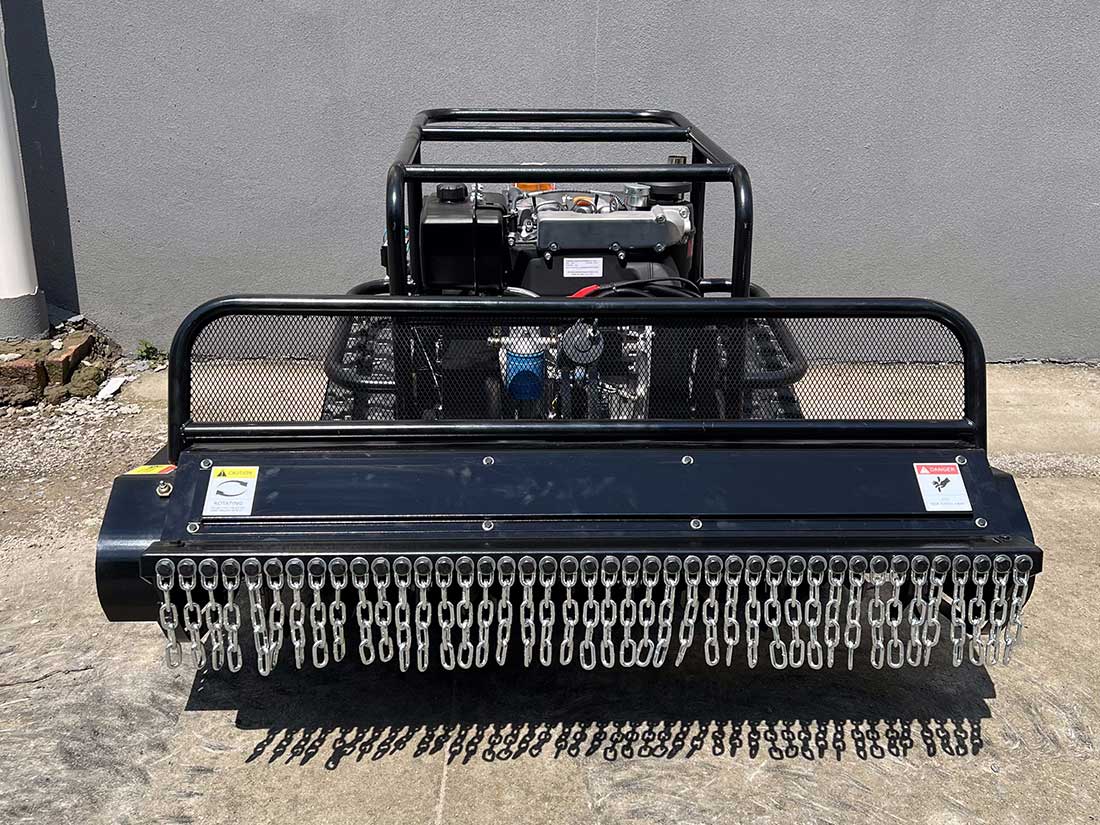
Grass height and vegetation density also determine which mower is appropriate. Rotary cutting systems may suit many routine grass-cutting applications, while flail cutting systems are often considered for tougher vegetation and light brush, subject to the machine's specified capabilities.
Compact designs for restricted access
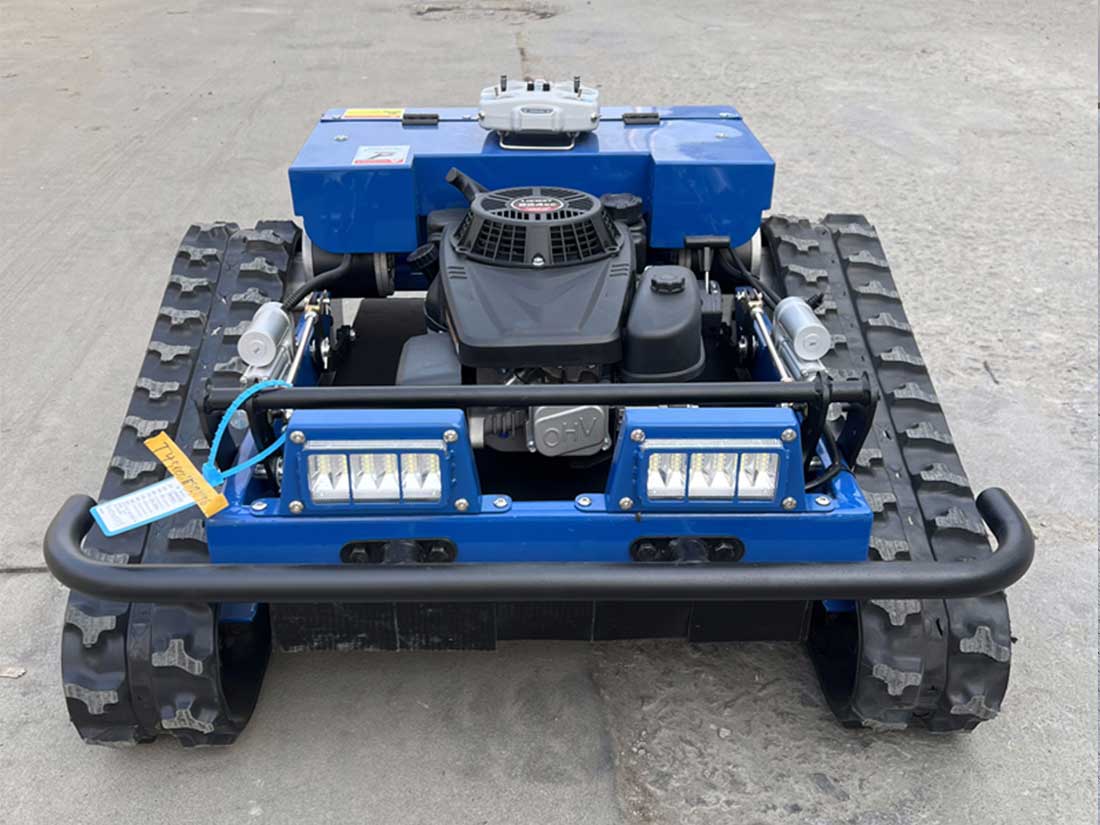
Some remote controlled lawn mower models have compact profiles that help them operate beneath low branches or around obstacles. This can be useful in orchards, vineyards, landscaped grounds, and certain solar farm maintenance applications.
Before selecting equipment, professionals should confirm the manufacturer's permitted slope limits, cutting capacity, ground clearance, and operating instructions. A machine designed for steep slopes is not automatically suitable for every surface or weather condition.
5. Choosing the Right Remote Controlled Lawn Mower
Selecting professional mowing equipment requires more than comparing prices or advertised engine power. Experienced buyers evaluate the complete machine, its operating environment, and the long-term demands of maintenance.
When comparing a remote controlled lawn mower, consider the following factors.
Selection factor | What professional buyers should evaluate |
|---|---|
Terrain capability | Maximum permitted slope, traction, stability, and ground clearance |
Cutting width | Whether the deck width suits the available space and required productivity |
Cutting system | Rotary or flail configuration based on grass, weeds, and light brush |
Power source | Engine or battery configuration, runtime, refueling, or charging needs |
Control system | Operating range, responsiveness, visibility, and emergency-stop functions |
Maintenance | Access to service points, replacement parts, and routine maintenance requirements |
Supplier support | Technical documentation, training, spare parts, and warranty terms |
Total ownership cost | Purchase price, transport, maintenance, consumables, and expected utilization |
A well-matched remote controlled lawn mower should meet the property's terrain requirements while providing a practical balance between cutting performance, operating costs, and serviceability.
Businesses should also distinguish remote-controlled equipment from autonomous robotic mowers. A remote-controlled machine is actively directed by an operator, whereas an autonomous mower may navigate or perform programmed tasks using its own control systems. The two technologies serve different operational needs.
6. How JUYOU Supports Remote-Controlled Mowing Applications
For businesses exploring specialized mowing solutions, choosing a supplier with a relevant product range is an important part of the purchasing process.
JUYOU presents remote-controlled mowing equipment for applications including steep slopes, embankments, orchards, roadside maintenance, and solar farms. Its product range includes wheeled and tracked configurations, with different machine sizes and cutting-system options for different working conditions. Availability and specifications should be confirmed for the individual model.
When evaluating a remote controlled lawn mower from JUYOU, prospective buyers can use the supplier's website to explore product configurations and make an inquiry based on their project requirements.
For a more useful equipment recommendation, prepare the following information before contacting a supplier:
The type of terrain and the steepest slope that must be maintained.
The predominant vegetation, including grass height and density.
The approximate area to be cut and the required cutting width.
Whether the application calls for a tracked or wheeled machine.
Preferred power configuration and expected daily operating hours.
The destination country and any relevant service or documentation requirements.
Providing these details makes it easier to compare suitable equipment configurations and obtain a quotation that reflects the actual application.
Explore available models and remote-controlled mowing solutions at https://www.jylawnmower.com/.
7. The Future of Remote-Controlled Mowing Equipment
Landscaping businesses increasingly need equipment that balances productivity, operator safety, adaptability, and operating costs. Remote-controlled mowing technology offers a practical option for meeting these demands, particularly when work involves difficult slopes, uneven ground, or restricted access.
Future improvements may focus on more responsive controls, improved machine monitoring, enhanced cutting systems, and more efficient power configurations. The value of these developments will depend on how reliably they perform under real working conditions and how well they integrate into existing maintenance operations.
For contractors, the objective is not simply to adopt the newest technology. It is to choose equipment that solves identifiable problems, supports consistent work quality, and delivers value over its service life.
A remote controlled lawn mower can be an important part of that strategy when selected for the right application and operated according to the manufacturer's guidance.
Conclusion
The remote controlled lawn mower is becoming a valuable option in modern landscaping because it gives professionals another way to approach challenging vegetation-management tasks. Its potential advantages include improved operator positioning, greater flexibility on difficult terrain, reduced reliance on manual trimming for suitable tasks, and more efficient allocation of specialized equipment.
However, results depend on machine configuration, terrain, vegetation, maintenance, and operator training. Careful equipment selection is therefore essential for achieving practical and sustainable improvements.
For landscaping contractors, agricultural operators, municipal maintenance teams, and commercial property managers, remote-controlled mowing equipment deserves consideration as part of a broader vegetation-management strategy.
To explore equipment options for slopes, rough terrain, and professional landscaping projects, visit JUYOU's official website and review the available remote-controlled mower models for your application.